Heat and Mass Transfer Applications
These are some applications of this course that greatly interest me. They could help me in my future career as well, so they are important for me to both understand and apply to the real world.
Insulation
Insulation in a wall or pipe creates thermal resistance, which decreases the rate of heat transfer through the object. Depending on the shape of the object, the resistance equation can change:


There is also a type of thermal resistance that can be used for fluids (aka convection):

Adding all the different resistance elements creates the total resistance, which can then be used to calculate the rate of heat transfer:

Since I am a visual learner, sketching out the flow of energy and where the differences in resistance occur can greatly help me understand the problem.
This heat transfer application is directly linked to my career. The amount of heat that can be retained in an insulated pipe is critical to understanding the outcome of a large project. It can also prove that the proposed design will (or will not) succeed.

Internal Food Temperature
The first step in finding the internal temperature of food while it is cooking is to determine if the temperature is changing uniformly throughout the object. This is known as lumped system analysis. To determine if you can use this specific type of analysis, you must find the Biot number, which is a dimensionless quantity that compares the conduction and convection of a certain object. If this value is less than 0.01, you can use lumped system analysis. For one-dimensional heat conduction, the internal temperature follows this equation:


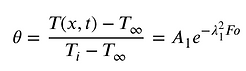
If lumped system analysis is not applicable, you must use a series of charts or graphs to determine the values for A and lambda. These are then plugged into the following equation to find the internal temperature of the object.
I love cooking for my family every holiday, and this concept comes into play constantly, especially when I'm baking cakes. Everyone knows that in order to safely eat cooked foods, you must cook them until a specific internal temperature. However, many people think that increasing the oven temperature will make it cook faster. Unfortunately, food cannot be considered a lumped system, so it cooks at varying temperatures within. This can result in gooey insides or worse... burned crust.
Greenhouses
Since greenhouses are made almost entirely of glass, a heating effect brilliantly known as the greenhouse effect takes place naturally due to the properties of glass. Simply put, glass allows solar radiation to enter, but radiation from the interior cannot exit. Glass allows light in the wavelength range of .3 um to 3 um to be transmitted through it. This wavelength range includes ~90% of solar radiation. However, radiation emitted by interior surfaces is considered infrared, which has a wavelength greater than 3 um. Because of the transmissivity of glass, solar radiation enters the structure while interior radiation "bounces" back in. The increased amount of radiated energy in the structure causes a drastic increase in the internal temperature, a perfect home for your plants.

One of my personal goals is to own a greenhouse and grow my own vegetables, as well as beautiful flowers. I have always wondered how greenhouses were able to stay so much warmer than the exterior temperature. As a kid, I thought glass was just a really good insulator... obviously, that is not the case. Instead, it is much more complicated and (in my opinion) much more interesting.